.png)


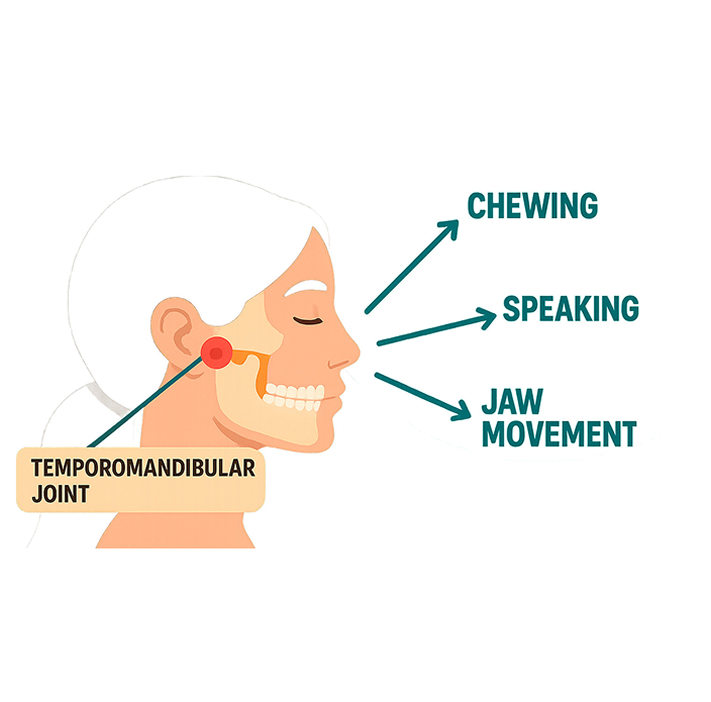
If your goal is to reduce jaw pain and you are hypermobile, you need a very different approach than what traditional TMJ care offers.
Because hypermobility changes the rules.
Your connective tissue is more compliant. Your joints don’t behave like “textbook joints.” Your nervous system has learned to stabilize through muscle recruitment rather than relying on passive structural stability.
And when it comes to the TMJ, this becomes especially important.
Because the TMJ is not just any joint.
It is the most neurologically and mechanically complex joint in the body.
It does not function in isolation.
It is part of a living system that includes your tongue, hyoid bone, cervical spine, airway, fascia, and nervous system.
When you are hypermobile, this system is inherently more adaptive—and often more protective.
Which means resolving TMJ pain is not about fixing a single joint.
It is about reorganizing the system that supports it.
Why Traditional TMJ Treatment Often Fails Hypermobile Bodies
Most treatment models assume the problem is local.
They focus on:
- The joint itself
- The bite
- The tongue
- Or isolated muscle strengthening
And while these interventions can sometimes reduce symptoms temporarily, they often fail to resolve the root cause in hypermobile bodies.
Because the instability is not local.
It is systemic.
Hypermobility reflects differences in connective tissue structure, proprioception, and neuromuscular coordination.
Ligaments that normally provide passive stability are more compliant. This means your nervous system must rely more heavily on muscular coordination and protective tension to maintain functional order.
Your jaw muscles are not gripping randomly.
They are stabilizing a system that does not feel fully supported.
Your tongue is not just “out of position.”
It may be compensating for instability in the hyoid, neck, and airway system.
Your forward head posture is not a posture problem.
It is a stability strategy.
Your body is doing the best it can with the structure it has.
The Referral Loop: TMJ Doctor → Physical Therapy → Still No Resolution
Many hypermobile TMJ patients go through the same sequence.
You see a TMJ specialist.
You try splints.
You try bite adjustments.
You try multiple interventions.
When the pain persists, you are referred to physical therapy or myofunctional therapy.
And this is where a critical gap often appears.
Most physical therapists are not trained to fully understand hypermobile connective tissue and its impact on jaw stability, nervous system regulation, and functional coordination.
This is not a criticism of the profession.It is a limitation of the education model.
TMJ dysfunction in hypermobile bodies requires understanding how:
The jaw interacts with the hyoid and tongue
The cervical spine influences jaw mechanics
The nervous system organizes stability through muscle recruitment
Fascia transmits tension across regions
Breathing mechanics influence jaw position and muscle tone
These relationships are rarely addressed comprehensively in traditional training. Some physical therapists do develop this level of expertise. But they are rare. And the difference is not their title. It is their understanding. Look for outcomes. Look for lived experience. Look for practitioners who understand that TMJ resolution in hypermobile bodies is a process of system reorganization, not isolated correction.
Because dumping money into treatments that do not address the root cause costs more than money. It costs time. It costs nervous system capacity. It costs hope.
And it reinforces the belief that your body is broken. It is not broken. It is adaptive.
The Missing Piece: Neuromuscular and Connective Tissue Integration
Resolving TMJ pain in hypermobile bodies requires restoring coordinated stability across the jaw, tongue, hyoid, neck, and nervous system.
Not forcing alignment. Not strengthening in isolation. But retraining the system to organize itself efficiently.
The suprahyoid muscles—including the digastric, mylohyoid, and geniohyoid—link the jaw, hyoid bone, and tongue into a single functional unit.
As described in anatomical literature:
“Suprahyoid muscles elevate the hyoid bone and facilitate mandibular movement.”
These muscles help coordinate swallowing, breathing, speech, and jaw stability.When they are dysregulated, the entire system compensates.
This can show up as:
- Jaw clenching
- Tongue gripping
- Swallowing dysfunction
- Forward head posture
- Chronic neck tension
- Persistent TMJ pain
Traditional approaches often attempt to correct individual parts. But hypermobile systems require retraining the relationships between parts.
This is the difference between symptom management and system resolution.
My Experience: From Hypermobility and TMJ Disorder to System Resolution
I know this not just as a practitioner. But as someone who lived it. As a hypermobile person with TMJ disorder, I experienced firsthand how traditional treatment models failed to address the root cause of my pain. I was told to relax. To strengthen. To correct posture. To train tongue position. To prepare for tongue tie release (which I never ended up doing). And yet the pain persisted. Because the problem was not a single muscle. It was the system.
Through years of study, experimentation, and direct neuromuscular retraining—including work with a TMJ-doctor-developed facial training device—I developed a method that focuses on restoring coordinated stability across the jaw, connective tissue, and nervous system.
Not forcing the body. But teaching it how to organize itself differently. When the nervous system no longer perceives instability, it no longer needs to maintain protective tension. And when protective tension resolves, pain resolves as a consequence. Not through force. But through restored function.
Every Hypermobility TMJ Case Is a Puzzle—But It Is Solvable
Every client I work with presents a unique pattern. Because hypermobile bodies are adaptive systems. There is no one-size-fits-all correction. There is only system reorganization. But when the underlying relationships between jaw, connective tissue, and nervous system are addressed, change becomes possible.
Not because the body was broken. But because it was waiting for the right inputs. Your connective tissue is not your limitation. It is part of your system. And when your system learns how to support itself, pain no longer serves a protective function.And it can finally let go.
What Happens When Hypermobility Receives the Right Inputs
While not all of my clients are hypermobile, a significant portion of them are.
And what I have observed again and again is this:
When hypermobile systems receive the right kind of care—care that respects connective tissue variability, nervous system sensitivity, and the need for coordinated stability rather than isolated correction—the body responds.
Not slowly.
But often rapidly.
Because hypermobile bodies are highly adaptive.
They have spent years compensating, stabilizing, and protecting.
And when they finally receive inputs that make sense to their nervous system—training that improves neuromuscular coordination, connective tissue support, and system-wide integration—the nervous system recognizes safety quickly.
And when safety is recognized, protective tension is no longer required.
This is when shifts happen.
Not because something was forced.
But because something finally made sense.
I have seen this in my clients.
And I have seen this in my own family.
My son came to me with jaw pain, carrying his own compensation patterns.
Using the same connective tissue and neuromuscular integration principles I teach, his system reorganized.
His pain resolved. His jaw function normalized.
And it shows too (face lift, jaw line pronounced with a bonus lip mass growth:)
Not through passive treatment.
But through targeted, intelligent retraining.
You can hear his experience in his own words here:
Link
If you are hypermobile and have been cycling through treatments that address parts of the system but never the system itself, know that your body is not resistant.
It is waiting for the right conversation.
And when that conversation happens, change becomes possible.